
Through a lot of trial, error, and student feedback, I think I have found the right combination of activities and pacing for my level 4 class. Hopefully, something that worked for me will work for you, as well.
If you have a hard time wrapping your head around what a comprehension-based curriculum looks like in upper levels like I did, I highly suggest taking a look at both Nuestra Historia from Voces, and Huellas from Somewhere to Share as starting points for what good resources for intermediate language learners looks like. What other curricula or resources do you all use in your upper level courses?
So here it is: the framework
Step 1 Topic Elaboration
When I was in college, we learned about turning topics into themes. Topics are typically how textbooks layout chapters: Family, Home, Pets, Food, etc..To expand those into a theme, I start thinking about essential questions, or enduring understandings.
Step 2 Assessment Planning
Based on backward design, before spending too much time on the resources, I want to start with how I will assess students formally. I include comprehension assessments throughout the unit, and because students need input before they can produce output, I save the output for the “formal” assessment. My go-to assessments are group speaking or writing. The easiest way for me to come up with a prompt is to go back to the essential questions or enduring understandings, and consider “how do we, outside of the classroom, use the answer to this question? Or, who is this information useful to, and how can we create something that would be helpful in sharing the info from the unit with someone who wants to learn about it?”
Step 3 Invoke Student Interest
I’ll be honest, I’m not the best at this, but here is a great list of Unit Hooks to get you thinking. For me, the best hooks get students moving, or using their senses, or showing a compelling video or story. Each unit should have different hooks, because our brains love novelty, so don’t be too predictable. I think using a ClipChat or TPRS story is a great way to introduce unit vocabulary as well as build interest.
Step 4 Annotating Articles and Collaborative Writing
Based on an activity that I learned from Bethanie Drew, I have made collaborative writing an *always* activity. It will always be in my units moving forward.
First, I divide the class in half, one half gets resource 1, the other gets resource 2. Students, independently, annotate the article. Shout out to my colleague, Dr. S, for reminding me that to annotate you have to have NOTES. Below is a screenshot of some annotation tasks that I ask students to complete on their article.
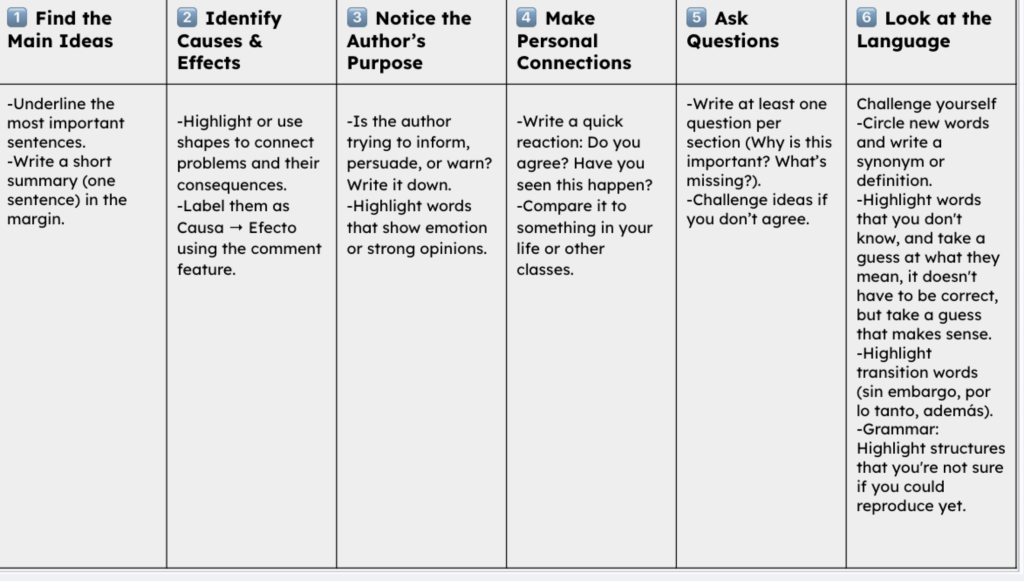
After students are done annotating, they pair up with someone who had the article they did NOT read. Then, students present the information that stood out to them the most, and collaboratively synthesize the two resources to respond to a prompt. I haven’t yet elaborated many prompts, but it could be something simple like “state your opinion on the topic based on your articles”, it could be a faux email (similar to the AP task), or it could be a cultural comparison. I guide students to write ONE strong paragraph.
Step 5 Class Review
TBH, review how you want. This is a good time for a review game, PQA/Class discussion.
Step 6 Infographics
Students choose one of three curated resources. They then must make an infographic. Read more about how I use infographics here: Is it Spanish class? Is it graphic design class? Or is it both?
I next have students present their infographics to each other, the goal is that all students have some knowledge about all three sources.
Step 7 Class Review 2
We need to consolidate the content knowledge to make sure everyone understands it well.
Step 8 Assessment
Now it’s time to assess!
Notes for Material Creation:
Especially for the articles that students annotate, I want to make sure that any new vocabulary is clarified, and is repeated robustly in all sources. Sometimes I find videos first that I’ll use for the infographics, so I go back and edit the articles to include more exposure to frequently used vocab from sources. But I often get stumped with how repeated vocabulary is and turn to AI to help me find where I can minimally modify a reading. I tell students, as well, that when I am talking they need to understand 100% of what I say, but in resources that might not always happen.
 Languageley
Leave a comment